 Most people pick up a dart for the first time and assume good aim is all it takes. But after a few wild throws that land nowhere near the board, they realize something is off. The truth is, throwing darts well comes down to a handful of mechanics, and once you understand them, improvement happens fast.
Whether you're stepping up to the oche for the first time or you've been throwing casually for a while and want to actually get better, The Corner in Ferndale is here to tell you what you need to know.
The Art of Throwing Darts at a Glance
- Your grip, stance, and release are the three things that matter most
- A relaxed grip beats a tight one almost every time
- Your elbow acts as a hinge, so keep it steady and pointed at the board
- Consistent follow-through is what separates a good throw from a great one
- Practice is more effective in short, focused sessions than long, unfocused ones
Start With the Right Grip
The grip is where most beginners go wrong, often because they're holding on too hard. Hold the dart with your dominant hand using your thumb and at least two fingers. Three fingers is the most common grip for new players. Your fingertips should rest on the barrel (the textured middle section of the dart) with light, steady pressure.
A few things to keep in mind:
- Do not curl your unused fingers into your palm. Let them relax outward naturally.
- Find the dart's balance point (usually near the center of the barrel) and grip near there.
- Avoid pinching the dart between your fingers. Think of it more as cradling than squeezing.
There is no single "correct" grip that works for everyone. What matters is that yours feels repeatable and comfortable. Experiment a little before locking anything in.
Find Your Stance
How you stand at the oche (the throw line) affects your balance, your sightline, and how smoothly you can deliver the dart. Position your dominant foot forward. Your feet should be staggered so your body is angled toward the board rather than squared up to it. Most players keep their front foot flat on the floor and shift their weight slightly forward.
Common stance styles:
- Side stance: Your body faces perpendicular to the board, with your dominant shoulder pointing toward the target. This is a popular choice because it minimizes body movement during the throw.
- Forward stance: Your dominant foot points straight at the board, and your body faces more forward. This can feel more natural for players coming from other throwing sports.
- Angled stance: A middle ground between the two, with the front foot angled roughly 45 degrees toward the board.
The key with any stance is staying still. Movement from the waist down during your throw introduces variables that are hard to compensate for.
The Throw: Elbow, Aim, Release
Once your grip and stance are dialed in, the actual throw becomes much simpler. Think of your arm as a machine with one moving part: your elbow.
Here's how a clean throw breaks down:
- Raise your arm so your elbow is up and your forearm is angled slightly back. Your dominant eye should have a clear line of sight to the target.
- Draw the dart back toward your face. Most players bring it near their eye, chin, or cheek. This is your anchor point, and keeping it consistent matters.
- Push forward from the elbow, keeping your upper arm as still as possible. Your forearm does the work here.
- Release the dart as your forearm reaches the point where it is roughly vertical. Think of it like flicking open a door; smooth and deliberate, not forced.
- Follow through by continuing your arm motion toward the target even after the dart leaves your hand. Your fingers should point at the board.
The follow-through is the part beginners most often skip, and it shows. Stopping your arm short at the release creates an inconsistent flight path.

Understanding the Board
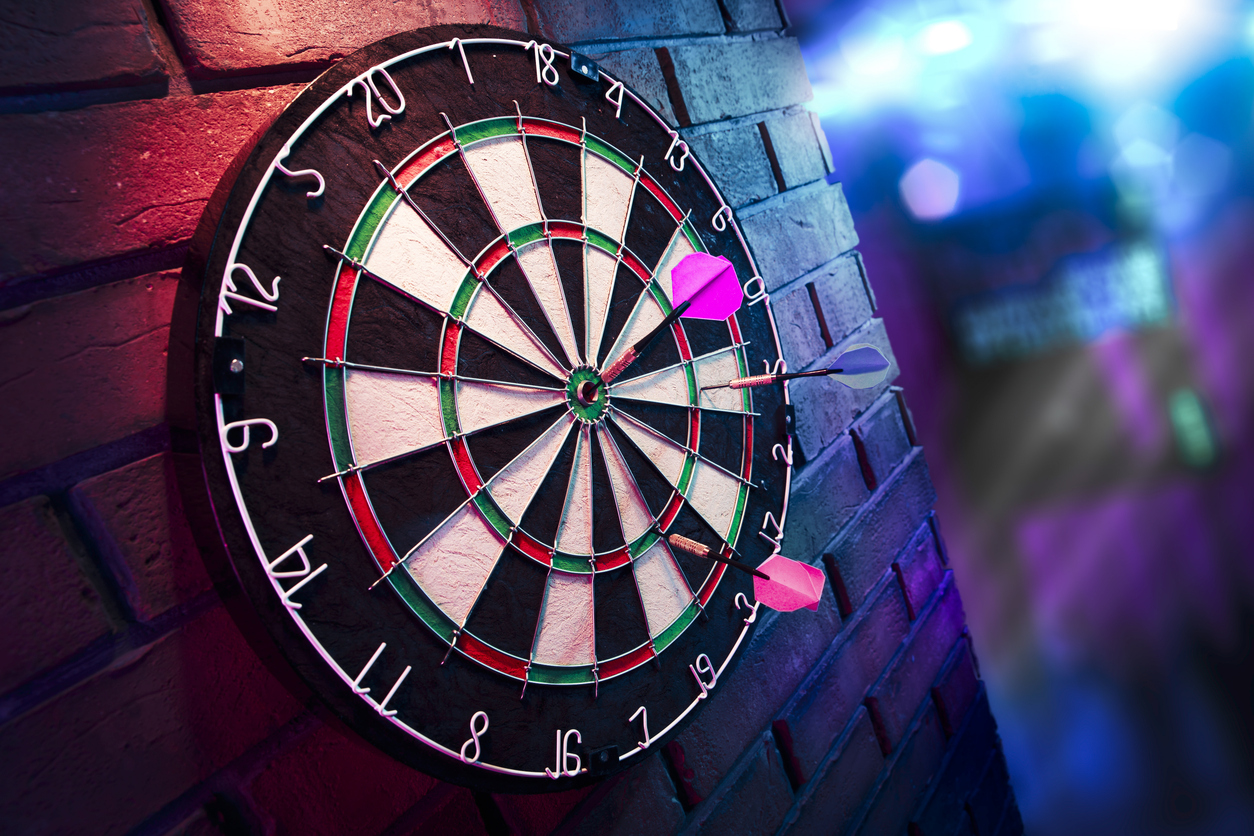
Knowing the board layout is just as important as knowing how to throw. A standard dartboard has 20 numbered sections arranged in a ring around a bullseye.
The scoring zones from outermost to innermost:
- Single: The main body of each numbered section
- Double ring: The thin outer ring doubles the section's value
- Triple ring: The thin inner ring triples the section's value
- Outer bull (25): The green ring around the center
- Bullseye (50): The small red or black center circle
For beginners, the goal is not to hit the bullseye. Focus on landing consistently in the larger single sections first. As your accuracy improves, you can start working on the doubles and triples.
Common Mistakes (and How to Fix Them)
Most beginner struggles come from a small set of repeatable mistakes. Here are the most common ones:
- Throwing too hard: Darts don't require power. A smooth, controlled release will outperform a hard throw every time. If your dart is bouncing off the board instead of sticking, ease up on the throw.
- Moving your elbow: If your elbow drops or swings outward during the throw, the dart will drift off course. Practice in front of a mirror to check your form.
- Rushing the release: Take a breath, find your anchor point, and let the throw develop naturally. Rushing leads to early releases and darts that sail high.
- Ignoring follow-through: As mentioned above, this one matters. Your arm should finish pointing at the target after every throw.
How to Practice More Effectively
A focused 20-minute practice session will do more for your game than two hours of casual throwing. Here's a simple routine to try:
- Around the clock: Aim for each number 1 through 20 in order. This builds board familiarity and forces you to adjust your aim rather than repeatedly throwing at the same spot.
- Double practice: Pick three doubles and throw at each until you hit them. Doubles are where games are won and lost.
- Grouping drill: Throw three darts at the same target and see how tightly clustered they land. Tight groupings mean your mechanics are consistent, even if your aim is slightly off.
Consistency is the goal at this stage. Don't chase accuracy before your mechanics are repeatable.
Frequently Asked Questions About Throwing Darts
How far do you stand from a dartboard?
The official throwing distance is 7 feet 9.25 inches from the face of the board to the oche. The board's bullseye should hang at 5 feet 8 inches from the floor. These measurements are the standard set by the World Darts Federation and are used across most organized play. They make a good baseline for setting up any board at home, too.
What weight dart should a beginner use?
Most beginners do well with darts in the 22--24 gram range. Heavier darts (24--26g) tend to fly straighter and are more forgiving of small grip inconsistencies. Lighter darts (18--20g) respond faster but require more control. If you can, try a few different weights before settling on one.
What is the oche in darts?
The oche (pronounced "ockey") is the throw line, which is the line you stand behind when you throw. In organized play, stepping over it during your throw is a foul. Most boards come with a simple oche marker, but a strip of tape works just fine if you are setting up at home.
The Basics Make All the Difference
Throwing darts well isn't about natural talent, but about building a few repeatable habits. Nail your grip, keep your elbow steady, and follow through on every throw. Get those three things working together, and you'll notice the difference faster than you might expect.
Ready to Step Up to the Board? Throw Darts at The Corner in Ferndale
Now that you know the basics, the best thing you can do is get some time on a board. The Corner has a dart lounge with reservable boards, comfortable seating, and food and drinks from our full menu waiting for you while you throw.
Come practice in a spot where showing up as a beginner is more than welcome. Contact us online or call (248) 291-5470 to reserve a dart board!