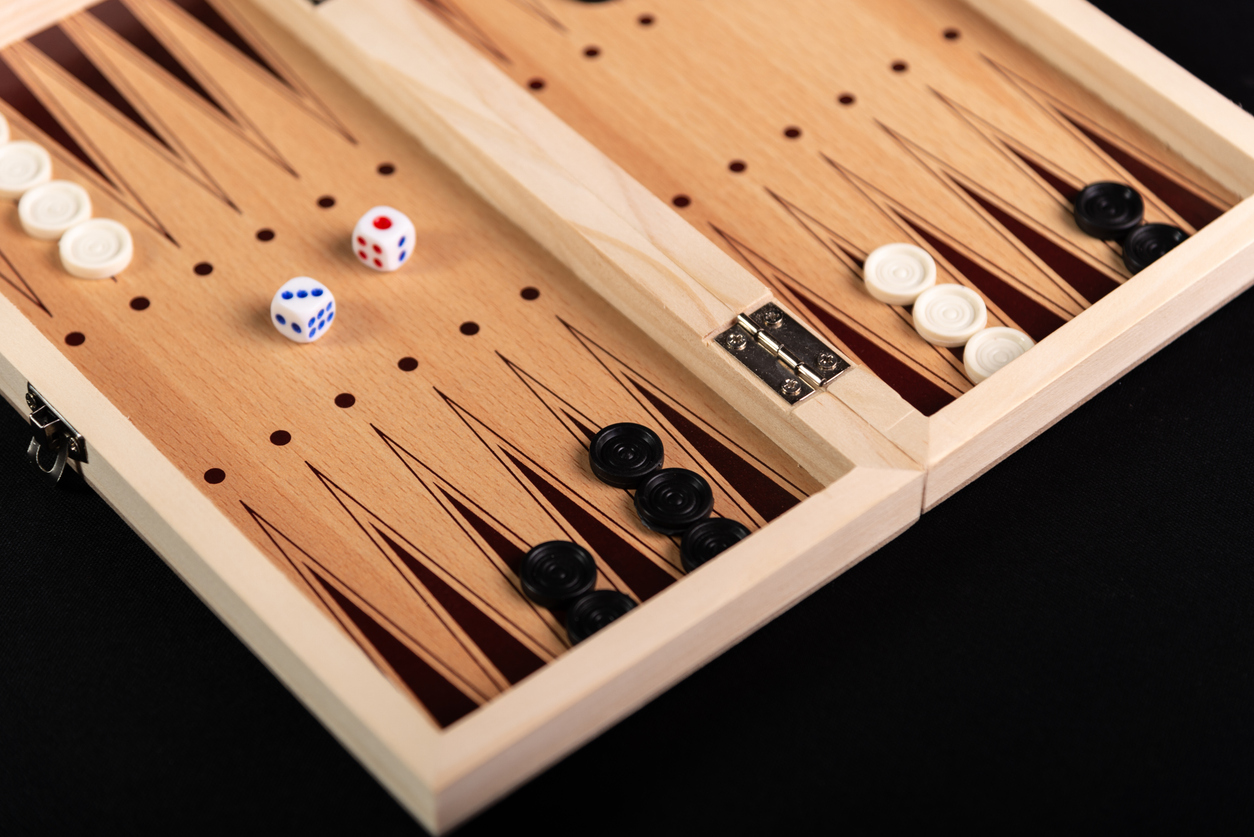
 Somewhere in ancient Persia, a scholar sits across from a rival. The stakes are high. The board between them is carved from wood and inlaid with stone. He shakes two dice in his fist, mutters something under his breath, and rolls.
Five thousand years later, you're at The Corner in Ferndale. Different drinks. Different dice. Same feeling.
That electric mix of strategy, luck, and pure human competitiveness; that's backgammon. It outlasted empires, survived church bans, conquered Monte Carlo casinos, and somehow ended up on a table near you. If any game has earned the right to brag, it's this one. So let's give credit where credit is due by exploring the surprisingly epic history of the world's oldest board game still in play.
It All Started Before Board Game Night
The story of backgammon begins roughly 5,000 years ago in the ancient region of Mesopotamia. Archaeologists digging at the ancient city of Shahr-e Sukhteh in Iran unearthed what's believed to be one of the earliest known game boards, dating back to around 3000 BCE. Complete with dice made from ebony and pieces carved from turquoise, this wasn't just a game; it was an event.
Around the same time, similar game boards were showing up across the ancient world. Royal tombs in the Sumerian city of Ur yielded beautifully decorated game sets that historians call the "Royal Game of Ur." While the rules of that particular game remain a mystery, the board layout and dice-based mechanics hint strongly at the family of games that would eventually evolve into backgammon.
Did You Know? Ancient Backgammon By the Numbers
- 3000 BCE: Oldest known game board discovered in Iran
- 5,000+ years of continuous play
- 2 players have faced off across every version of this game throughout all of recorded history
- 0 rule books survived from antiquity
The Persian Connection
Fast forward a few thousand years to ancient Persia, where a game called Nard was all the rage. This is where backgammon's lineage gets really interesting.
According to Persian legend, the game was invented as a philosophical tool to represent the eternal struggle between fate and free will. The board symbolized the universe: the 24 points represented the hours of the day, the 30 pieces stood for the days of the month, and the two dice? Those were destiny. Heavy stuff for a Tuesday night game, right?
The Persians were so proud of Nard that a famous 6th-century text called the Wizishn i chatrang (explanation of chess) describes the legendary contest between Persian and Indian sages. This is where the Indians brought chess, and the Persians countered with Nard. Spoiler: both sides claimed victory. It's the world's oldest documented flex.
Rome, Greece, and the Ancient Party Circuit
By the time the Roman Empire was at its peak, a version of the game called Tabula was spread across the Mediterranean like wildfire. And we do mean across — Roman soldiers were credited with carrying the game to every corner of their empire, from Britain to Egypt.
Emperor Claudius was reportedly such a massive fan of Tabula that he had a special board installed in his chariot so he could play while traveling. Consider this the ancient Roman version of gaming on your phone during a commute.
The game became a fixture in Roman taverns and public bathhouses, a social ritual as natural as sharing a meal. Sound familiar? That communal, laid-back energy is something we like to think The Corner carries on in spirit.
A Medieval Makeover
After the fall of Rome, backgammon didn't disappear, it was just branded. The game spread through the Byzantine Empire, into the Arab world, and eventually into medieval Europe via trade routes and Crusader travels.
In medieval England, the game picked up the name Tables and became immensely popular; so popular, in fact, that several kings tried to ban it. Edward IV attempted to prohibit his troops from playing in 1477, worried that the game was distracting soldiers from archery practice.
By the time the 17th century rolled around, the game had evolved significantly and picked up the name we know today: backgammon. The word likely comes from the Middle English "bac gamen," simply meaning "back game," a reference to the mechanics of sending pieces back to the start. The rules had solidified into something remarkably close to what we play in modern times.
One Game, Many Names: Backgammon's Passport Through History
- 3000 BCE Mesopotamia & Persia Nard
- 200 CE Roman Empire Tabula
- 600 CE Arab World Tawiah
- 1000 CE Medieval England Tables
- 1600s Britain & Europe Backgammon
The Doubling Cube Changes Everything
Here's where things get spicy. For thousands of years, backgammon was a game of pure strategy and probability. Then, sometime in the 1920s, someone introduced a doubling cube.
This small but mighty innovation completely transformed the game's strategic landscape. The doubling cube allows players to raise the stakes during a game, adding a layer of psychological warfare that goes far beyond just moving pieces. Now you had to read your opponent, manage risk, and decide when to fight and when to fold.
The doubling cube is the reason backgammon tournaments became so intense, and why serious players can spend years mastering the game's finer points. Think of it as the game's glow-up moment.
Backgammon Goes Global
Through the mid-20th century, backgammon became a fixture of jet-set culture. In the 1960s and 70s, it was the game of choice in chic European resorts, Monte Carlo casinos, and Manhattan penthouses.
The World Backgammon Championship, held annually in Monte Carlo starting in 1967, drew players and spectators from around the globe. Suddenly, backgammon wasn't just a parlor game; it was a sport with serious players, serious prize money, and a serious social scene. Today, the BGWC is still hosted annually in Monte Carlo.
A backgammon craze swept the United States in the 1970s, with tournaments popping up in cities from coast to coast. Backgammon sets became status symbols — leather-bound, custom-crafted, ludicrously expensive.
Some Famous Faces Who Couldn't Put the Board Down
- Lucille Ball: Reportedly played constantly on set between takes
- Cary Grant: A fixture of the Monte Carlo tournament scene
- Prince Charles: Played regularly and helped popularize the game in British high society
- Hugh Hefner: Hosted backgammon nights at the Playboy Mansion throughout the 70s
- Oswald Jacoby: World-class card player who became one of the first great backgammon champions and co-wrote the definitive rule book
The Digital Age and the Comeback
Like many classic games, backgammon hit a bit of a lull in the 1980s and 90s, as video games took over living rooms. But it never really went away, and then the internet gave it a massive second wind.
Online backgammon platforms in the early 2000s introduced millions of new players to the game. More importantly, the rise of neural network-based backgammon programs — particularly a program called TD-Gammon developed in the early 1990s — revolutionized how people understood backgammon strategy. For the first time, computer analysis revealed that many "standard" moves humans had relied on for decades were actually suboptimal.
Today, backgammon is thriving. International tournaments attract world-class players from dozens of countries. Online communities debate openings and endgames with the same fervor as chess forums. And locally? People are rediscovering the joy of sitting face-to-face, rolling dice, and letting the game play out.
Why We Love Backgammon at The Corner
There's something timeless about backgammon that fits perfectly with what we're all about here at The Corner. It's a game that rewards skill without punishing beginners too harshly. It moves at the perfect pace for a conversation; fast enough to stay exciting, slow enough to actually talk between turns. It's competitive without being cutthroat, social without being frivolous.
Whether you're a seasoned player who knows the pip count before the dice even land, or someone who picked up the rules last week, backgammon has a set for you.
So next time you're in, grab a board and your friends, and start rolling. And remember: you're participating in a 5,000-year-old tradition that's connected humans across empires, continents, and centuries. Not bad for a weekday game night.
Come Visit Our Board Game Wall in Ferndale, MI
The Corner is located in downtown Ferndale, on Nine Mile Rd. We offer guests delicious food, a welcoming atmosphere, cold drinks, and an extensive board game wall with a variety of games to choose from. Here, everyone's welcome at the table.
Walk-ins are always welcome here, but to guarantee you and your friends have a spot, we recommend reserving a game table. See you soon for a night of competitive fun!